
competitive-programmingDec 31, 20211 min read
[LeetCode] 15. 3 Sum Explained
Updated: Dec 31, 2021
Two pointers
Available in:enko
#Problem
#Approach
The brute force approach is , but .
That's calculations? It (of course) gives TLE.
Once you fix the first index , the problem turns into finding values such that .
Sort the array and, for each , run two pointers as shown below.
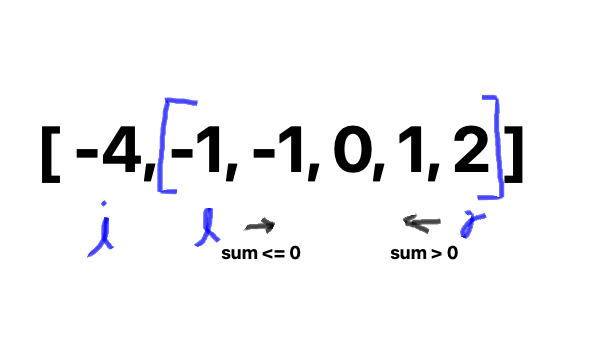
When implementing, I reduced unnecessary calculations by skipping when the element value stays the same after moving the indices.
#Code

/**
 * written: 2021. 12. 31. Fri. 16:46:01 [UTC+9]
 * jooncco의 mac에서.
 **/

typedef vector<int> vi;
typedef vector<vi> vvi;

class Solution {
public:
    vvi threeSum(vi &nums) {
        int n= nums.size();
        if (n < 3) return vvi();

        // 오름차순 정렬
        sort(nums.begin(), nums.end());

        // 순회하면서 two pointers를 수행
        set<vi> ans;
        for (int i=0; i < n-2; ++i) {
            int l= i+1, r= n-1;
            while (l < r) {
                if (nums[i] + nums[l] + nums[r] == 0) {
                    ans.insert({nums[i], nums[l], nums[r]});
                }

                if (nums[i] + nums[l] + nums[r] > 0) {
                    // 같은 값 skip
                    while (l < r-1 && nums[r-1] == nums[r]) --r;
                    // r을 왼쪽으로
                    --r;
                }
                else {
                    // 같은 값 skip
                    while (l+1 < r && nums[l] == nums[l+1]) ++l;
                    // l을 오른쪽으로
                    ++l;
                }

            }
        }
        return vvi(ans.begin(), ans.end());
    }
};
#Complexity
- Time:
- Space: