
[Java] What is JPA?
Updated: Mar 6, 2024
Spoiler
This post explains the concept and structure of JPA, along with a rough overview of how it works.
#What is JPA
#Java Persistence API
The java ORM standard for storing, accessing, and managing java objects in a relational database
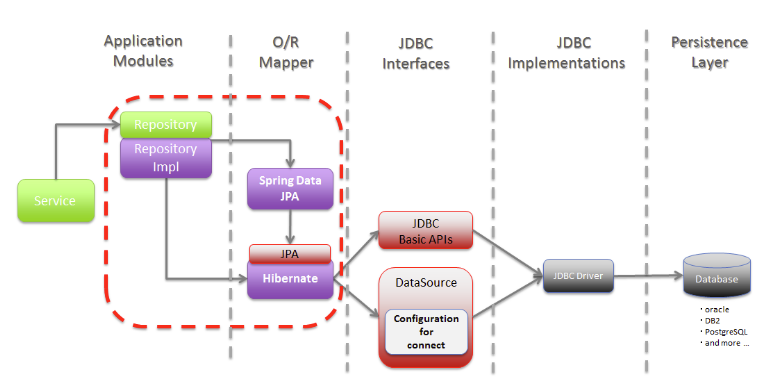
- It is an API defined in Java, and it is both the ORM standard and a specification.
- Since it is not an implementation, it does not perform any action on its own.
- A representative implementation is Hibernate, which maps Java objects to DB tables.
- Some JPA implementations also support NoSQL DBs (EclipseLink).
JDBC: Java DataBase Connectivity
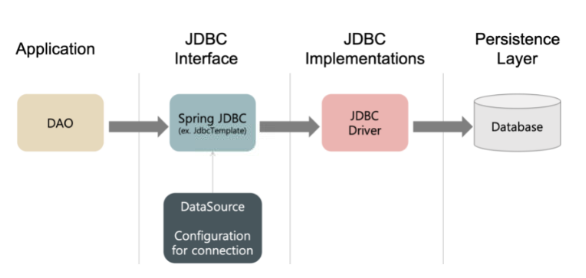
A Java API defined to manage the connection between the DB and a Java app and to pass queries along. You can assume that nearly every Java-based Data Access Layer uses it internally. JPA, too, ultimately accesses the Persistence Layer through JDBC.
#The Difference Between ORM and SQL Mapper
#ORM (Object-Relational Mapping)
Object Relation(Tables)
- It resolves the paradigm mismatch between objects and table data.
- It lets you handle DB data indirectly from application code through objects.
- It automatically generates SQL statements so that the developer does not have to write SQL directly.
- A representative implementation is Hibernate.
#SQL Mapper
Repository methods SQL statements
- The developer must write SQL directly in xml form.
- The SQL statements you write are mapped to the methods of the application repository.
- If the DBMS changes, the application code also needs to change.
- Representative implementations are Mybatis and JdbcTemplate.
#Advantages of JPA
- The developer can delegate SQL to JPA and focus on business logic.
- Because there is no DB Vendor dependency, you can change the DBMS without changing the application source code.
- It supports JPQL (Java Persistence Query Language), which lets you write queries through objects.
- You can enjoy the benefits of optimizations (lazy loading, caching, write behind, etc.).
#Persistence in JPA
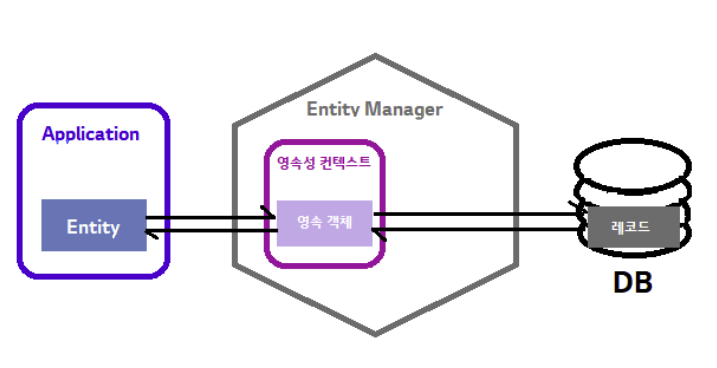
To implement persistence, JPA manages something called the persistence context.
Suppose that JPA's Entity Manager is active and, within a transaction (a scope annotated with @Transactional), an object of a class managed as an Entity is declared.
At this point, the persistence context of this object is maintained, and in this state, if you change the value of a member variable, the data of the table record to which that object is mapped is updated at the moment the transaction ends. The update occurs even without calling an update method in the source code, and this is called a Dirty check.
- If you use Spring Data JPA, the Entity Manager is active by default.
- The persistence context is a set that holds entities, and it cannot be accessed directly (only through the Entity Manager).
#How JPA Works
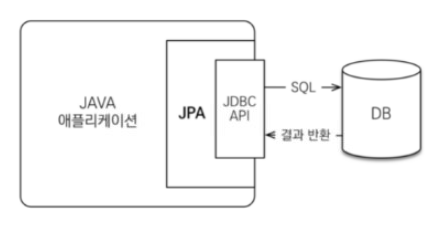
- The backend logic calls a JPA API method (e.g.,
persist) - JPA's implementation (e.g., Hibernate) generates a query
- The generated query is passed to the DB through the DB connection managed by JDBC
Let's take a closer look with examples.
#insert
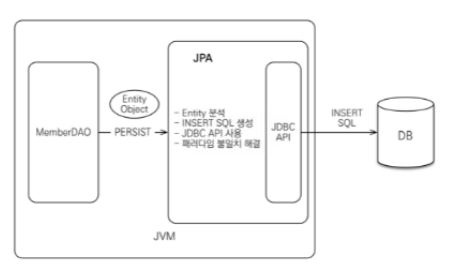
When the persist method of the Member Entity is called:
- Inspect the Member object
- Generate an INSERT SQL by the JPA implementation
- Pass the generated query to the DB through a JDBC API call
#find
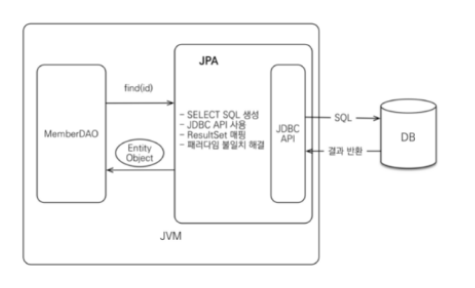
When the find method of MemberRepository is called:
- Check whether the Entity object already exists in the persistence context (in memory)
- If it exists, return that Entity
- If it does not exist, generate a SELECT query by the JPA implementation
- Pass the generated query through a JDBC API call
- Put the retrieved data into the fields of a Member object and return it
#Optimizations JPA Handles for You
JPA is also middleware, and among the methods that middleware commonly uses to improve performance, there are the following two.
- Minimizing overhead through
Buffering - Improving query performance through
Caching
Let's briefly look at what these mean.
#Buffering
Transactional write-behind
#insert
public void jpaExampleService() {
  transaction.begin();

  jpaRepository.save(entityA);
  jpaRepository.save(entityB);
  // 여기까지는 entityA, entityB와 관련된 테이블 데이터에 변경이 없다.

  transaction.commit(); // DB connection이 이때 할당되고 테이블 데이터가 변경된다.
}
#update
public void jpaExampleService() {
  transaction.begin();

  jpaRepository.update(entityA);
  jpaRepository.delete(entityB);
  // 여기까지는 entityA, entityB와 관련된 DB 테이블 데이터에 변경이 없다.
  doBusiness(); // 비즈니스 로직을 수행하는 동안 DB lock이 발생하지 않는다.

  transaction.commit(); // DB lock을 이때 획득. 변경사항이 테이블 데이터에 반영된다.
}
#Caching
If it is recent data that has already been queried, no DB query is generated or passed along.
public void jpaExampleService() {
  String entityId= "sameId";

  Entity instanceA, instanceB;
  instanceA= jpaRepository.find(Entity.class, entityId); // entity 조회
  instanceB= jpaRepository.find(Entity.class, entityId); // cached retrieval

  boolean isInstanceSame= instanceA == instanceB; // true
}
#Lazy loading
Defers the query until the moment the data is actually used.
Let's say Team : Member = 1 : N.
The Member entity holds, as a member variable, the Team entity corresponding to the team it belongs to.
public void jpaExampleService() {
  Member member = memberRepository.find(memberId);
  // SELECT * FROM member WHERE member_id = memberId;

  Team team = member.getTeam();
  // No SQL executed here

  String teamName = team.getName();
  // SELECT * FROM team WHERE team_id = member.teamId;
}
In the example above, query passing happens twice.
However, if in most situations the Team data is also referenced whenever the Member data is referenced, you can consider Eager Loading.
#Eager loading
: A strategy that fetches in advance all of the associated objects
public void jpaExampleService() {
  Member member = memberRepository.find(memberId);
  // SELECT *
  //   FROM member WHERE member_id = memberId
  //   JOIN team WHERE member.team.team_id = team.team_id;

  Team team = member.getTeam();
  // No SQL executed here

  String teamName = team.getName();
  // No SQL executed here
}
The default setting of a JPA implementation is Lazy Loading.
It is recommended to investigate how frequently the Member entity and the Team entity are referenced together, and to apply Eager Loading only when they are referenced together in most cases.
#Wrapping Up. Spring Data JPA
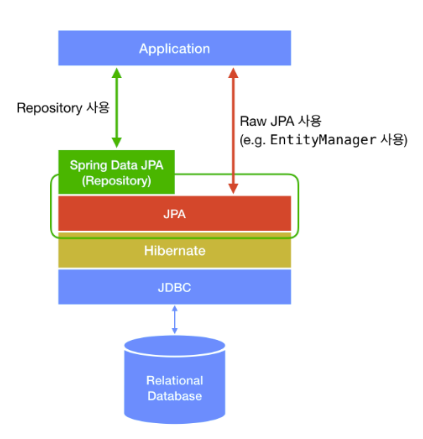
JPA and Spring Data JPA are decidedly different. (light green and red)
Spring Data JPA is a kind of framework provided by the Spring framework to make it easy to use a JPA implementation (e.g., Hibernate), and it lets you easily swap the JPA implementation and the connected DB via application configuration.
- When Java's Redis client shifted its mainstream from Jedis to Lettuce, if you had been using Spring Data Redis, the swap would have been effortless.
- Because the subprojects of the Spring Data project such as Spring Data JPA, Spring Data mongoDB, and Spring Data Redis implement the same interface (findAll, save, etc.), you do not need to modify Java source code even if you change the DB.